

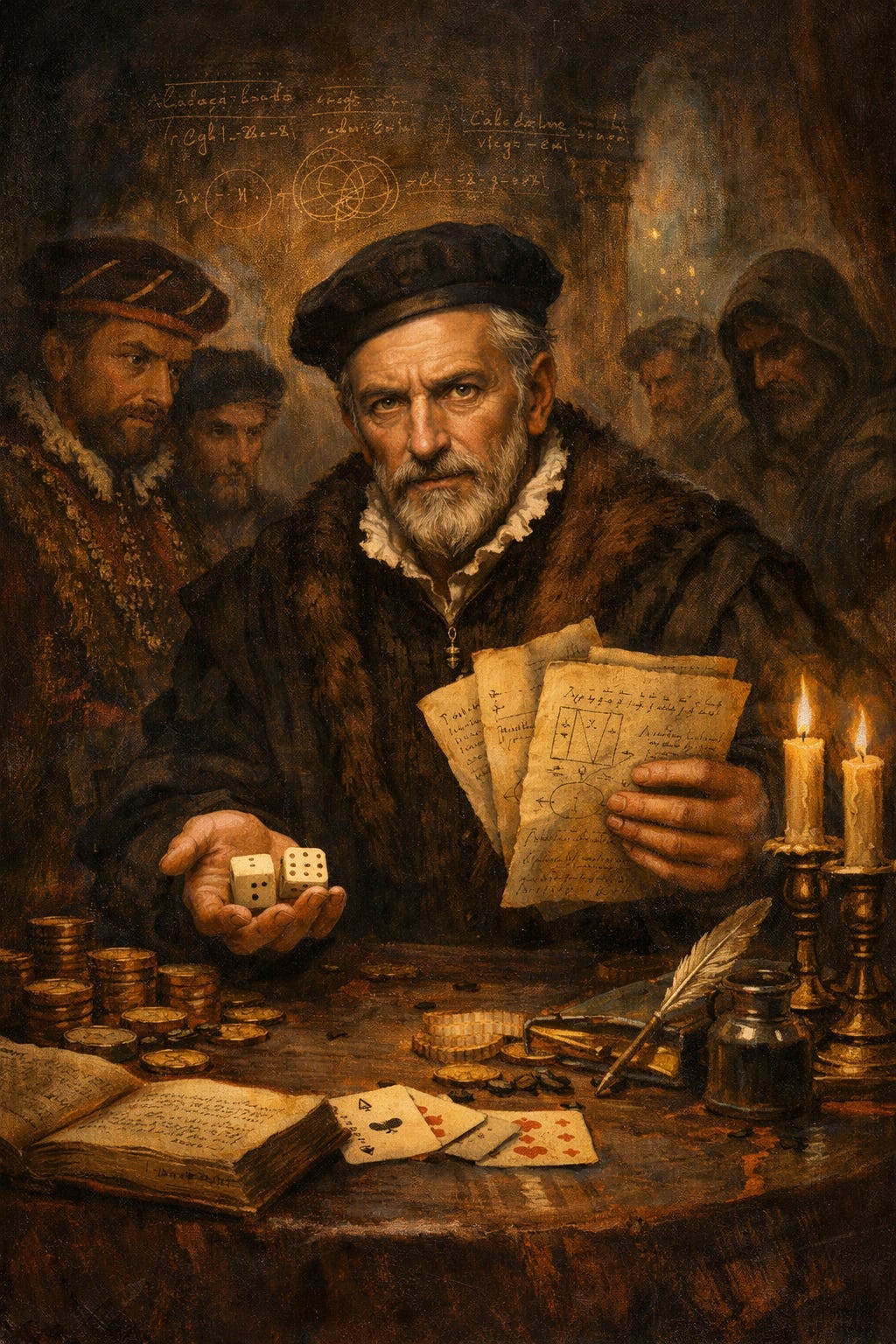
In the turbulent heart of Renaissance Italy, where plagues ravaged cities and wars redrew borders, Gerolamo Cardano’s life unfolded not as a steady ascent to genius, but as a series of lurches—fortunes won and lost, brilliance shadowed by betrayal. Born on September 24, 1501, in the bustling town of Pavia, he entered the world as the illegitimate son of Fazio Cardano, a sharp-witted jurist and mathematician who counted Leonardo da Vinci among his friends, and Chiara Micheri, a young widow desperate enough to attempt abortive herbs during her pregnancy. The labor lasted three grueling days, and Chiara fled Milan for Pavia to escape the Black Death, which had already claimed her other three children. From the start, Cardano’s existence was precarious—a roll of fate’s dice.
His childhood offered no respite. Plagued by illnesses—fevers, abscesses, and a weak constitution—he endured beatings from his overbearing father, who pushed him toward law while Cardano’s mind wandered to philosophy, science, and the stars. Fazio, despite his temper, taught the boy geometry and astrology, igniting a lifelong fascination with patterns in chaos. At nineteen, Cardano enrolled at the University of Pavia, but the Italian Wars of 1521–1526 forced a transfer to Padua, where he earned his doctorate in medicine in 1525. Eccentric and abrasive, he clashed with peers and authorities. His illegitimacy barred him from Milan’s College of Physicians, so he practiced unlicensed in the rural village of Piove di Sacco, scraping by amid poverty and rejection.
Marriage brought fleeting stability. In 1531, he wed Lucia Bandarini, a kind woman from a modest family. They settled in Milan, where Cardano secured a mathematics lectureship thanks to noble patrons. Their children arrived—eldest son Giambattista in 1534, daughter Chiara in 1537, and youngest Aldo Urbano in 1543—and for a time, Cardano called this his happiest era. Lucia’s death in 1546 shattered that illusion, leaving him to raise the family alone. By then, his medical reputation had grown; he treated nobles and scholars, quitting teaching in 1539 after the College finally admitted him. He turned down royal offers—from the kings of Denmark and France, even Scotland’s queen—preferring independence, though financial woes lingered.
Cardano was no mere healer or scholar; he was a polymath, his mind a whirlwind of invention. In mathematics, his 1545 masterpiece Ars Magna revolutionized algebra, publishing solutions to cubic and quartic equations—though not without controversy. The cubic formula had first been discovered by Scipione del Ferro and later rediscovered by Niccolò Tartaglia, who guarded it jealously and revealed it to Cardano only after extracting an oath of secrecy. Cardano, having learned that del Ferro had independently solved the problem earlier, convinced himself that the oath no longer bound him. He published the method in Ars Magna, crediting both del Ferro and Tartaglia—but Tartaglia saw it as betrayal. The dispute erupted into public accusations and pamphlets, culminating in a humiliating mathematical contest in 1548 between Tartaglia and Cardano’s brilliant student Lodovico Ferrari. Tartaglia lost badly, and his reputation never fully recovered.
Within the same volume, Cardano also included Ferrari’s solution to the quartic equation, extending algebra beyond anything Europe had yet seen. He pushed further still—accepting negative numbers as meaningful, experimenting with what he called “sophistic” numbers (early forms of imaginary numbers), and laying out systematic treatments of binomial coefficients and expansions. The book did not merely solve equations; it announced that algebra could penetrate problems once thought impossible.
Beyond equations, he engineered marvels: the combination lock to secure secrets, the gimbal for steady compasses on rocking ships, and the Cardan shaft with universal joints, still powering vehicles today. He also devised the Cardan grille, a cryptographic tool for hidden messages, and advocated for educating the deaf, insisting they could read and write without speech.
But survival demanded more than intellect. Chronically short on cash—despite treating high-profile patients like Scotland’s Archbishop John Hamilton in 1552, curing his asthma-like ailment for 1,400 gold crowns—Cardano turned to gambling and chess. He was not a casual player; dice were his lifeline, supplementing his income in Milan’s taverns and courts. He observed cheats and habits, admitting in his candid autobiography De Vita Propria Liber (1576) that he sometimes rigged games himself. This gritty world inspired his groundbreaking work, Liber de Ludo Aleae (The Book on Games of Chance), penned around 1564 but published posthumously in 1663.
Here, amid personal storms, probability emerged from the shadows. Cardano’s insight was deceptively simple: to tame uncertainty, count everything. Assume outcomes are equally likely, tally the total possibilities, then the favorable ones, and divide. This wasn’t vague philosophy; it was cold arithmetic stripping mystery from risk. Take two six-sided dice: 36 ordered outcomes, from (1,1) to (6,6). The sum of 7? Six ways: (1,6), (2,5), (3,4), (4,3), (5,2), (6,1). Probability: 6/36 = 1/6. Eleven? Just two: (5,6), (6,5). Odds: 2/36 = 1/18. He grasped asymmetries others ignored, such as how doubles (e.g., 4–4) occur once per 36 rolls, about 2.8%, while mixed rolls like 4–3 are twice as likely.
In the candlelit chambers of the Milanese court, this illustrative example captures the atmosphere in which the scent of expensive wine mingled with the tension at the gaming table, and Gerolamo Cardano watched his patron, the nobleman Galeazzo II Visconti, navigate the fine line between fortune and ruin. Visconti and his circle were not mathematicians, but they were survivors of the velvet-draped pits. They possessed a budding intuition—a ghostly sense of the odds that defied formal explanation yet governed their gold.
Cardano observed that these seasoned gamblers could feel a deficit invisible to the amateur. They could sense the microscopic friction between a 1/8 (12.5%) chance and a 1/10 (10%) chance. To a casual observer, the difference is a mere whisper; to a man whose estate is on the line, it is the sound of a closing trap.
Cardano stripped away the nobleman’s gut feeling and replaced it with the cold light of expected value. Imagine a wager where the payout is 8 units and the entry cost is 1 unit. If the true probability is 1/8, the math holds steady: at a cost of 1 unit per play, you are simply trading breath for breath and breaking even. But if the probability shifts ever so slightly to 1/10, the engine of wealth begins to stall. Suddenly, every 1-unit entry is a 0.2-unit loss in disguise.
Over a single roll, this gap is an imperceptible phantom. But Cardano knew that the dice have a long memory for patterns, if not for individual results. Over a season of play—say, 1,000 throws—the nobleman who relies on luck finds himself staring at a 200-unit deficit.
Cardano’s genius was not in discovering that these margins existed; the scarred veterans of Visconti’s court already suspected the game was tilted. His innovation was to formalize the instinct. He transformed the vague feeling of a seasoned gambler into a rigid ratio. He proved that what the court called destiny was simply arithmetic structure. By the time the candles burned low in Milan, Cardano had done the unthinkable: he had taken the mystical vibration of the dice and pinned it to the page as law.
Cardano went further, intuiting expected value—a concept that would define modern economics and decision theory. Multiply payoff by probability: a bet paying 10 units on a 1/6 chance yields 10 × (1/6) ≈ 1.67 units in expected value. If it costs 2 to play, walk away. He noted that independent events multiply (e.g., two coin flips resulting in heads: 1/2 × 1/2 = 1/4) and warned of gamblers’ fallacies: overvaluing rarities and mistaking streaks for destiny. Dice, he insisted, have no memory—each throw resets the slate.
Yet fate mocked his calculations. Tragedy struck like loaded dice. In 1560, Giambattista—Cardano’s promising eldest, a doctor himself—married Brandonia di Seroni, rumored to be promiscuous. The union soured when he learned her three children were not his. Accused of poisoning her with arsenic-laced cake, he was arrested, tortured into confession, and beheaded despite Cardano’s desperate pleas and failed bribes. The loss crushed him; he blamed academic rivals in Pavia for influencing the trial. Aldo, the youngest, spiraled into gambling addiction, stealing jewels and money from his father, leading to his disinheritance in 1569. Daughter Chiara died young, her fate a quiet wound amid the noise.
Exile followed. Cardano fled to Bologna in 1569, teaching medicine, but heresy charges loomed. In 1570, the Inquisition jailed him for months over his astrological writings—including a horoscope of Jesus in a 1543 almanac supplement, deemed blasphemous. He abjured, lost his post, and saw his non-medical works banned. Pope Pius V denied aid, but his successor Gregory XIII granted him a Roman annuity in 1572. There, Cardano practiced quietly, philosophized, and penned his raw memoir until his death on September 21, 1576—some say fulfilling his own astrological prediction by starving himself.
The paradox endures: a man whose life careened through illegitimacy, loss, and imprisonment birthed the science of measured chance. He didn’t invent dice or combinatorics—those stairs rose from ancient algebraists like Al-Karaji. But Cardano climbed them to the gaming table, turning counts into cash and uncertainty into law. In the gap between his son’s unquantifiable doom and a die’s tallyable faces, probability was forged—not as escape from chaos, but as its map.